
Widal.Factory
Tickets in. Reviewed pull requests out. In your own cloud.
Widal.Factory hands your tickets to AI coding agents. Each agent opens a pull request, and your engineers review and merge it. It runs on your cloud infrastructure, and we operate it, so you keep your code, your data, and control over our access.
The path of one ticket
- 01TicketEngineer
Labels a ticket in Linear or GitHub Issues. That is the hand-off.
- 02BriefFactory
Makes a git worktree and branch, and starts one coding agent with the ticket, the repo and your rules.
- 03QuestionAgent
Asks on the ticket when something is unclear, and waits for the answer instead of guessing.
- 04Pull requestAgent
Pushes the branch and opens a pull request. Your CI runs on it like on any other.
- 05ReviewEngineer
Reviews the pull request. Comments go back to the same agent, which fixes and pushes again.
- 06MergeEngineer
Merges. The factory closes the ticket, cleans up, and records time and cost.
The agents
- Read the ticket and the code
- Write the change and the tests
- Open the pull request and answer review comments
- Ask when the ticket is unclear
Your engineers
- Decide which tickets go to an agent
- Answer the agents' questions
- Review every pull request
- Merge. Nothing reaches your main branch without a person
We run it. You own it.
On your cloud infrastructure
AWS today. Google Cloud and Azure are set up on request. The factory, its data, its backups and its encryption keys live in your own account. We deploy, update and monitor it there.
Our access is yours to control
We work through roles you create from a template you can read first. Every action shows in your cloud audit log. You can remove our access at any time.
Your model account
Agents use Claude through your own cloud or Anthropic account, under your agreements. You pay the model provider directly, with no markup from us.
A factory per engineer, one hub
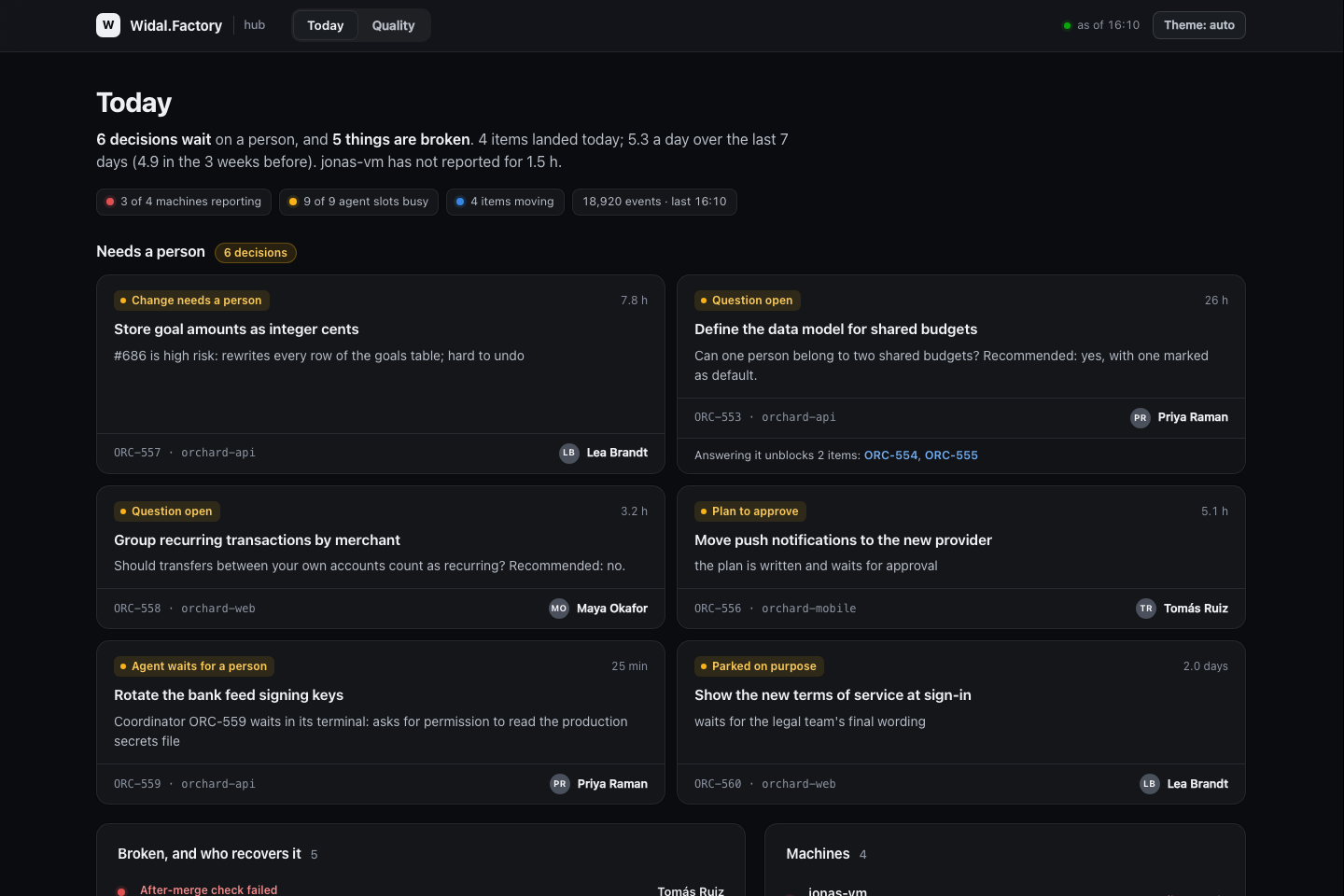
Each engineer gets their own factory in its own virtual machine, so one person's agents never touch another's work. Every factory reports to one hub: what agents are doing, what waits for a person, and what each merged change cost.
Platform credits. Engineers included.
You commit to a yearly amount of platform credits and spend them on what you use. Our forward deployed engineers come with it. Start with a four-week pilot that counts toward your first year.
Pilot
four weeks, paid as creditsOne team, one repo. Every dollar counts toward your first year if you continue.
- We set up the factory in your own AWS account
- A forward deployed engineer works with your team, included
- Workflows, rules and checks tuned to your codebase
- A written read-out: what landed, what it cost, what to change
Platform credits
credits a year (1 credit = $1)Credits pay for what you use. Each engineer's factory uses 500 credits a month. The hub has no seat fees.
- Each engineer gets their own factory, and the team gets one hub
- Updates, monitoring, backups and incident response
- Department packages, as they become available, use credits too
- Unused credits carry over within the year
Forward deployed engineers
with every credit commitmentA named Widal engineer works with your team for as long as you run the platform.
- Setup, onboarding and new workflows
- A weekly review of what agents got wrong, turned into rules and checks
- Help writing and validating checks for regulated work
- Larger builds can be added as a pod, paid in credits
Not ready for a pilot? A one-week architecture read costs $20,000 and counts toward your credits if you sign within 30 days. Model use is billed by your cloud provider or Anthropic, through your own account, typically $150 to $250 per developer per month. Your cloud costs are billed by your cloud provider. We mark up neither.
- What is a credit?
- One credit is one dollar of platform use. You commit to a yearly amount, and use it for what you run: each engineer's factory uses 500 credits a month, and department packages will use credits as they become available. There are no seat fees for the hub.
- What do the forward deployed engineers cost?
- Nothing extra. A named Widal engineer comes with every credit commitment, for setup, new workflows and the weekly review. Larger builds can be added as a pod, paid in credits.
- Can agents merge on their own?
- No. Every pull request needs a person to review and merge it. Agents hold no GitHub key of their own, and with your main branch protected, nothing reaches it without a person.
- Does our code leave our account?
- The code stays in your cloud account and your GitHub. The agents send code to the model you choose, through your own cloud or Anthropic account.
- Which trackers and agents does it work with?
- Linear, GitHub Issues and Jira. Claude Code today, and other coding agents can be added. The full list is under How it works, Integrations.