
For life sciences, healthcare and other regulated companies
AI agents that do real work at regulated companies.
Each agent follows a written workflow, runs in your own cloud, is tested by fixed checks, and waits for a person to sign. We start with your engineering team and add one department at a time.
Fixed steps
A written workflow sets the order of the work.
Fixed checks
Tests that give the same answer every time.
A person signs
Nothing is final without a named approval.
Your cloud
It runs in your own account, under your agreements.
Engineers who have shipped for








How it works
Four steps, the same for every department.
The agent does the work. Your written workflow decides the order, fixed checks decide if it is good enough, and a person decides if it is final.
- 1
A person hands off work
A ticket in Linear or GitHub Issues today. Later, for example, a deviation report or a prior authorization request.
- 2
An agent does it
It follows your written workflow, inside your own cloud account, and asks a person when something is unclear.
- 3
Fixed checks test it
Scripts that give the same answer every time. If a check fails, the agent tries again, up to a set limit, then a person takes over.
- 4
A person signs
Nothing is final without a named person's approval. Every step is recorded.
Why this way
AI on its own is fast but unpredictable. We make it dependable.
Giving everyone a chat tool or a coding agent is a start. For regulated work it is not enough.
Fixed steps
A written workflow sets the order. The AI only does the parts that need judgment.
Source: Anthropic, Building effective agentsFixed checks
Tests and scans that give the same answer every time. In Veracode's tests, 45% of AI code samples failed security checks.
Source: Veracode, GenAI Code Security ReportTight limits
Agents hold no keys and cannot change production on their own.
Source: OWASP, Top 10 for LLM Applications 2026Measured
Every run's time and cost is recorded. How people feel about AI speed is not a measure.
Source: METR, randomized trial (2025)Words we use
What we mean, in one line each.
- Agent
- An AI program that does a task, such as writing code or drafting a report.
- Workflow
- The written steps for a job, in order, that the agent must follow.
- Check
- A fixed test of the agent's work that gives the same answer every time.
- Sign-off
- The point where a named person approves, as your procedures require.
- Hub
- One page for the whole company: what agents are doing, and what waits for whom.
- Factory
- An engineer's own machine in your cloud, where coding agents work on that engineer's tickets.
- Pull request
- A proposed change to the code, which a person reviews before it is merged.
Start with engineering · running today
Widal.Factory: coding agents for your engineering team.
Your engineers hand tickets to coding agents. Each engineer gets a factory: their own machine in your cloud, where the agents work. All factories report to one hub, so the team sees what every agent is doing and what waits for a person. We operate it with you.
- 1Ticket
An engineer hands a ticket to the factory in Linear or GitHub Issues.
- 2Build
One coding agent gets the ticket, the repo and your rules, and works in its own branch.
- 3Pull request
The agent opens a pull request, a proposed change. Your tests run on it.
- 4Review and merge
Your engineer reviews, the agent fixes, your engineer merges.
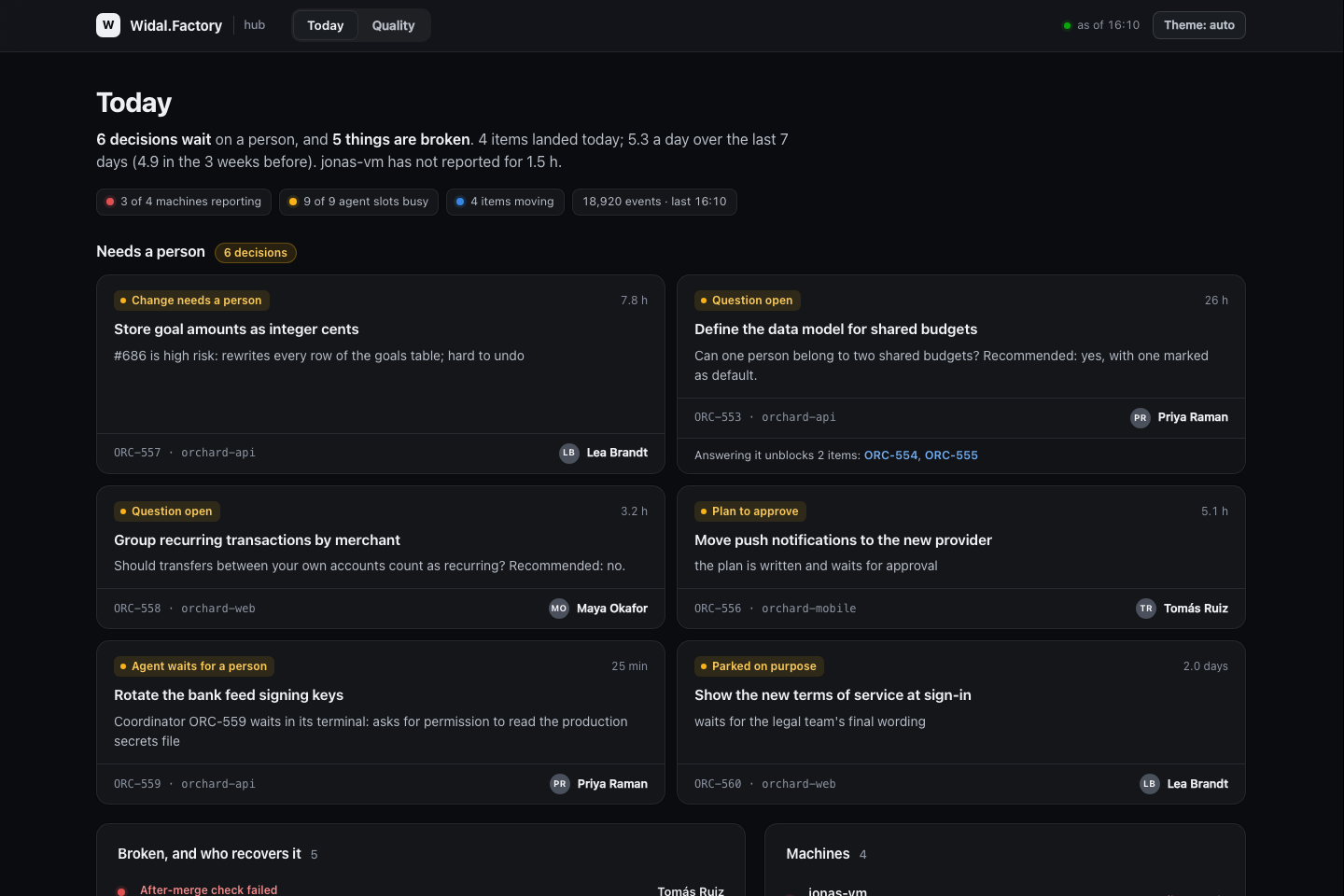
Then add departments
One department at a time, on the same base.
Each department gets its own agents, workflows and checks, and shows up in the same hub. Engineering runs today. The others are planned, and we build each one with a design partner.
Engineering
Tickets become reviewed code changes. Reviews, fixes and merges.
Quality
Deviations and CAPA records drafted from the evidence, for a person to approve.
Regulatory affairs
Submission sections drafted from source documents, with citations.
Clinical operations
Site and study documents prepared and tracked.
Patient support and access
Benefits checks and prior authorization packets prepared.
Safety
Adverse event reports drafted from the intake.
Built for regulated work
Validate the workflow and the checks, not the model.
An AI draft is never the same twice. The workflow around it is. You validate the workflow and its checks once. Every draft must pass them on every run before a person signs. It all runs in your own cloud account, under your own agreements, with a record of every step.
HIPAA · FDA 21 CFR Part 11 · GxP · SOC 2
This is how we design for these rules, not a certification. Your quality team decides how it applies.
How we handle regulated workWork in production for healthcare companies.
Recent work our engineers built for healthcare companies, before and alongside the platform.
Virtual care platform for a primary care network
Visits, two-way sync with the electronic health record (EHR), readings from home devices, and AI drafts that clinicians review. Built on FHIR, across a multi-state network.
Claims, eligibility and prior authorization
Automation added on top of an existing AdvancedMD setup, without replacing it. A person reviews the cases that do not fit the rules.
Remote patient monitoring with early alerts
Readings from home devices, with alerts when a patient may be getting worse. Tuned to ignore device noise, and sent to the clinicians' inbox.
Online pharmacy at Mark Cuban Cost Plus Drugs
Core parts of the online pharmacy platform: the backend, scaling and the customer experience, for a company built on open drug prices.
Who sets it up
Our engineers install it and run it with you.
Senior engineers who have shipped software in regulated companies join your team. They are the same people who build the product.
1 week
Architecture read
One or two senior engineers read your code and systems and write down what to hand to agents first, and what not to.
4 weeks
Pilot
We set it up in your cloud for one team, tune the workflows and checks, and write up what landed and what it cost.
ongoing
Run
We operate it with you: updates, monitoring, and a weekly review that turns agent mistakes into rules.
Tell us which work you want to hand off first.
The first conversation is a 30-minute call with two senior engineers, not a sales team. We read what you send first, and we come prepared.
- Direct
- hello@widal.com
- Response
- Within one business day, written by an engineer.
- Coverage
- Based in San Francisco. Engineers in the Americas, Europe and Asia, who work in your time zone.